That one letter
"One letter. The terror didn't disappear, but it transformed into joy"
Neal Katyal
Few lawyers command a record like Neal Katyal's. More than fifty arguments before the Supreme Court, a stint as Acting Solicitor General, and a reputation as one of America's most formidable legal minds. Last year, he took on the biggest case of his career.
And yet, standing in the chamber of the Supreme Court, he felt like an imposter. He'd look up at the portraits lining the walls, all those legal giants who'd come before him, and the same thought would surface: they don't look like me. I don't belong here.
Pressure, as it turns out, doesn’t disciminate by experience or seniority. Whether you're arguing before the highest court in the land or walking into a meeting with people you're sure know more than you, the internal experience is remarkably the same.
As Neal puts it, "imposter syndrome doesn't care about how many cases you won. It cares only about your doubts."
In the weeks before the biggest case of his career, a media groundswell had been building, and all that pressure had crept into Neal's language.
I've got to win this. I've got to do a great job. I've got to remember 500 different things. I've got to deliver an argument for history.
Enter Crowey, who'd been supporting Neal with his mindset work in the lead-up, walking him through key perspective shifts and Mojo principles. He had one small adjustment to offer.
"What if we swap one vowel? The O for an E. Because you've either got to do this, with all the weight and expectation that carries. Or you get to do this.
You get to stand up for what you believe in. You get to represent families like your own. You get to do this in honour of everything your parents fought for.”

As is always the case with this tool, it almost sounds too simple. And yet the shift it unlocks is anything but.
Because "got to" keeps the spotlight on you, your fear, your performance, the 500 things you have to perfectly execute. "Get to" opens it up to something much bigger: gratitude for the opportunity, and maybe even a sense of your why, or who you're really doing it for.
For Neal, that bigger thing was deeply personal.
His father, a Punjabi immigrant who'd arrived in America shortly before Neal was born, had passed away not long before the case. It had always been their ritual for Neal to call him the night before an argument, and this would be the first time stepping into court without that call. So he brought his father with him another way.
The morning of, before leaving for court, he posted a photo of his kada, the Sikh steel bracelet worn as a symbol of discipline and moral accountability, resting on top of his case files.
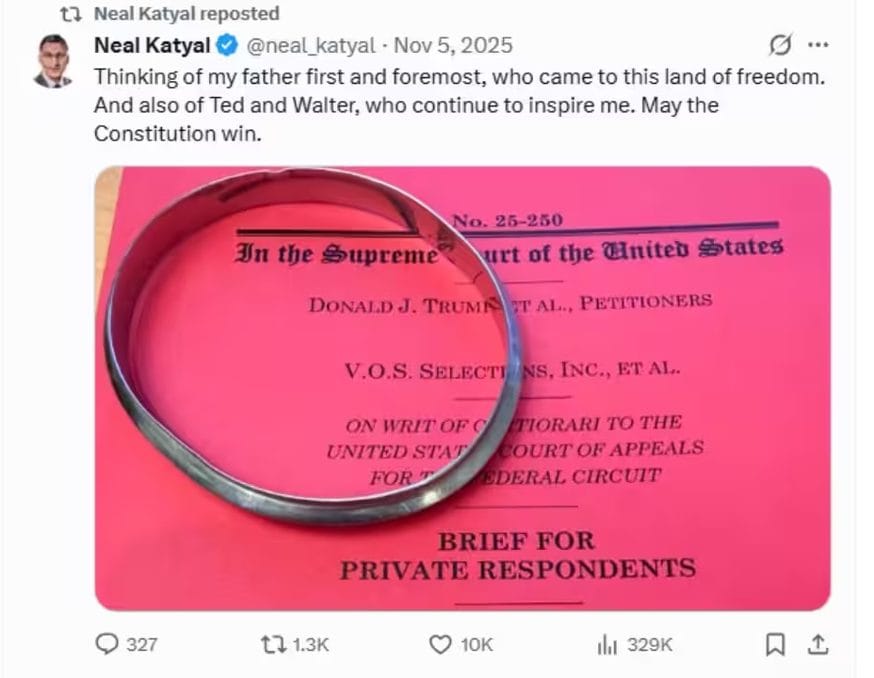
"I was so calm and present from that point on,” he recalls. “A connection between my head and my heart. I could not wait to get in there."
That's the simple genius of this shift. "I've got to win" is a closed fist. "I get to do this, for them" is an open hand, shifting you from powerless to powerful.
It won't make the fear disappear. If anything, our emotions tend to persist the more we try to resist them.
But a single swapped letter can bring us back to three powerful mindset muscles that are within our control, and are useful anchor points to focus on: acceptance of how we're feeling, however that may be; agency, in choosing to tell ourselves a different story; and appreciation, in the shift from the got to the get.
All three principles, wrapped up in one letter.
Got to > Get to…
"The terror didn't disappear, but it transformed into joy."